


Note: This interview is not part of The Whining Family podcast (new episodes coming soon!) but it is about a social group that is LIKE family to one another…plus it features an extraordinary person who is mentioned in Chapter 30 of The Winning Family!

You know I run with a glamorous crowd.
I sometimes get to immerse myself in a happy fantasy world where we’re all movie stars in a universe of our own imagination, with agreed-upon parameters such as red lipstick and not hogging the best dancer. This fancy society has been a refuge, many times, from the ugly and political world—but this spring, things got political…and sadly spun out of control.
On the last Saturday in April, the historic Paramount Theatre in Oakland was filled with music and dancing from its heyday, as members and guests of the Art Deco Society (ADSC) gathered for their annual Preservation Ball, celebrating those who have gone to lengths to preserve the architecture, art, and culture of the era between the two world wars. This was the 40th anniversary of the first time this ball was held, also at the Paramount, which had at that time been recently restored to its spectacular original 1931 interior. Those now-elderly citizens were honored, along with those who attempted but sadly failed to keep Berkeley’s last historic theater from closing; a couple who creates historic dining experiences; and a 96-year-old dancer not by any means on his last legs. Reigning over the festivities was event producer Laurie Gordon, who herself was being celebrated for her final fête, as the founder of the Society and original instigator of its cultural (and FUN) preservation events in Art Deco buildings that have been adopted by all Art Deco societies around the world! Laurie also directs The Decobelles, a show-stealing dance troupe that has given hundreds of women (me included) the opportunity to be part of a performance sisterhood.
Present at the ball were generations of guests wearing vintage or remixed finery, the women in long gowns, the men in tuxedoes, with an elegant smattering of cross-dressing. A lot of women (like me) were wearing gold and white, perhaps feeling the grandeur of Art Deco’s centennial moment. We took turns descending the staircases dramatically (as one does), gawping at the architecture, and spinning partners on the dance floor.
But.
There are always a few “outliers” at Art Deco Society events that either don’t understand the costume assignment, try to make a statement, or just don’t fully pull off a concept. This year there was one couple who wore chinoiserie, which is not unusual, but they pulled focus by also wearing matching conical hats…and, um, long braids down their backs? They caused some whispers that night, but not a scene. But a few days later, their costume choice became a scandal, reverberating on social media like the famous science lesson torsion wave that took down that Art Deco era bridge.
Many had been offended by the costumes. Those who had personally experienced anti-Asian hatred in their lives were deeply shaken, triggered. Then a blogger published a hard-hitting exposé of the event, amplifying the distress. The author, Regina Jordan, does the important work of confronting issues of diversity in Hollywood, then and now. But this time she was not taking issue with the blatantly racist past from which we walk a tightrope when we draw our inspiration. Instead she attacked the perception of the ADSC. Jordan’s list of allegations pulled the entire community of creative dressers into a divisive controversy on social media that asked a single question: why weren’t these people kicked out? Another writer, Marissa Firebaugh, provided a more helpful in-depth article explaining why the cosplayers were so hurtful to members of the AAPI community. It was an eye-opening education for every reader about “Yellowface,” a.k.a. the “caricature-izarion” of Asian people, just as racially offensive as Blackface, but which still flies under the radar. The ADSC has been on a DEI learning curve over the past few years, with new procedures in place after decades of tolerating harmless transgressions and combatting unsophisticated (aka tasteless or rude) behaviors with education and support. But it was not prepared for what came next.
Neither of these writers were present that night. Both of them had attended past ADSC events, even as “featured celebrities”, where both gained many new friends and fans. (Including me; Marissa aka “cheekychopsueyart” is a fab illustrator who makes paper dolls yay!)

Jordan had, in her first article, deliberately “not blamed Laurie Gordon” as the the event’s producer and ADSC visionary, but nonetheless demanded she be held responsible. Soon everyone but everyone clamored for an apology by Laurie, who was blindsided by the uproar. Laurie sent an email to Firebaugh explaining why she did not personally, or in her position, ask the guests to leave, then in early June, the latter took her words out of context and posted a series of 14 slides, disparaging Laurie with a damning statement insinuating that she, personally and singlehandedly, was the source of the Club’s decay. Some of Laurie’s friends reposted it.
Here are some things no one knows about Laurie Gordon. Her father spent a year as a POW in WWII. He spent the rest of his life promoting diversity, tolerance and inclusion. He and Laurie’s mom threw her into the deep end when she was ten, sending her to a summer camp for black kids when her friends were going to Horse Camp, Jewish Camp, Girl Scout Camp. They wanted her to experience life as a minority. She made lots of friends and asked to go back the next year. In high school she developed her leadership in the Anytown Leadership Camp Program which is still a respected training ground for the emotional realities of Diversity, Equality and Acceptance. In college, where she was a Psychology major, Laurie chose to be involved with interracial programs, gay rights and equality issues. Her gay friends introduced her to Art Deco, collecting, vintage, historic preservation, and the power of theater and events as a vehicle for social change. In the interview she tells some interesting stories about the battles she’s fought in the ADSC. And how exasperated she is at how young people with whom she has much in common are handling things.
Over a month later, both writers confronted the couple, who were now dressed in regular regalia, at the Avalon Ball, and created a scene. (The ADSLA doesn’t seem to have a Code of Conduct.) Meanwhile, the ADSC’s official apology was rejected by these two plus a few upset members, who now demanded Gordon’s removal. In a move that stunned the membership, the board complied, severing all ties with Gordon and the Decobelles—yet that still wasn’t enough. Even though the organization is both renaming and moving the location for The Gatsby Summer Afternoon, the two started a movement calling for a boycott. It seems they want to destroy the whole organization. Regina even used the ADSC’s logo in a “gotcha” post (I am struggling to avoid using the term “yellow journalism” but id the shoe fits.. ) publishing its financial information and boasting “We name the names when no one else will.”
It is strange to me, as part of this collection of fun sophisticates who for years have explored 20th century history together from the inside out, that not a single person talked about the mid-century connection with what’s happening in the real world. In this rainbow-blue bubble community, we try to be allies—to become educated, to educate one another, to learn and grow—and to do the right thing. But in the outside world, people are losing their jobs, their funding, and their lives because the we can’t even USE the words “diversity, equity, and/or inclusion in this country anymore. The irony to me is that Laurie and Marissa would surely fight tooth and nail (Jungle Red?) for each other’s safety if they were rounding up, say, Asian or Jewish people, but were turned against each other because everyone had the freedom of speech to express their feelings.
I considered using words like “social justice warriors” and “reverse dog whistle” and “virtue signaling” and “woke vigilantism” in this essay, but I hate that tone, even though I know some were thinking along these lines. This is not how we want our society to engage. Many people held their tongues, too angry, afraid, and/or embarrassed. They felt vulnerable, and sad that the community does not appear as inclusive as it thinks it is or wants to be. They sat silently as the community tore itself apart on guesses, assumptions, wildfire rumors, and un-opposed accusations. Even though the trouble came from those who felt oppressed, the silence felt as heavy as if Big Brother was watching. In public, everyone agreed with the writers, and not a single person gave Laurie, who is very beloved by the community, the benefit of the doubt. The emotion of it felt so nuanced and strange that I wanted to hear her side of the story. Laurie challenged a younger me to find new brave new parts of myself, appearing in public in a woolen bathing suit, teaching me how to be photographable, if not photogenic. After my “glamour debut” modeling a Ginger Rogers gown down a spiral escalator, she made some more of my life’s most thrilling moments possible, like the time I danced with fruit on my head. I know how much she cares about what she does, and felt she deserved to have her say.
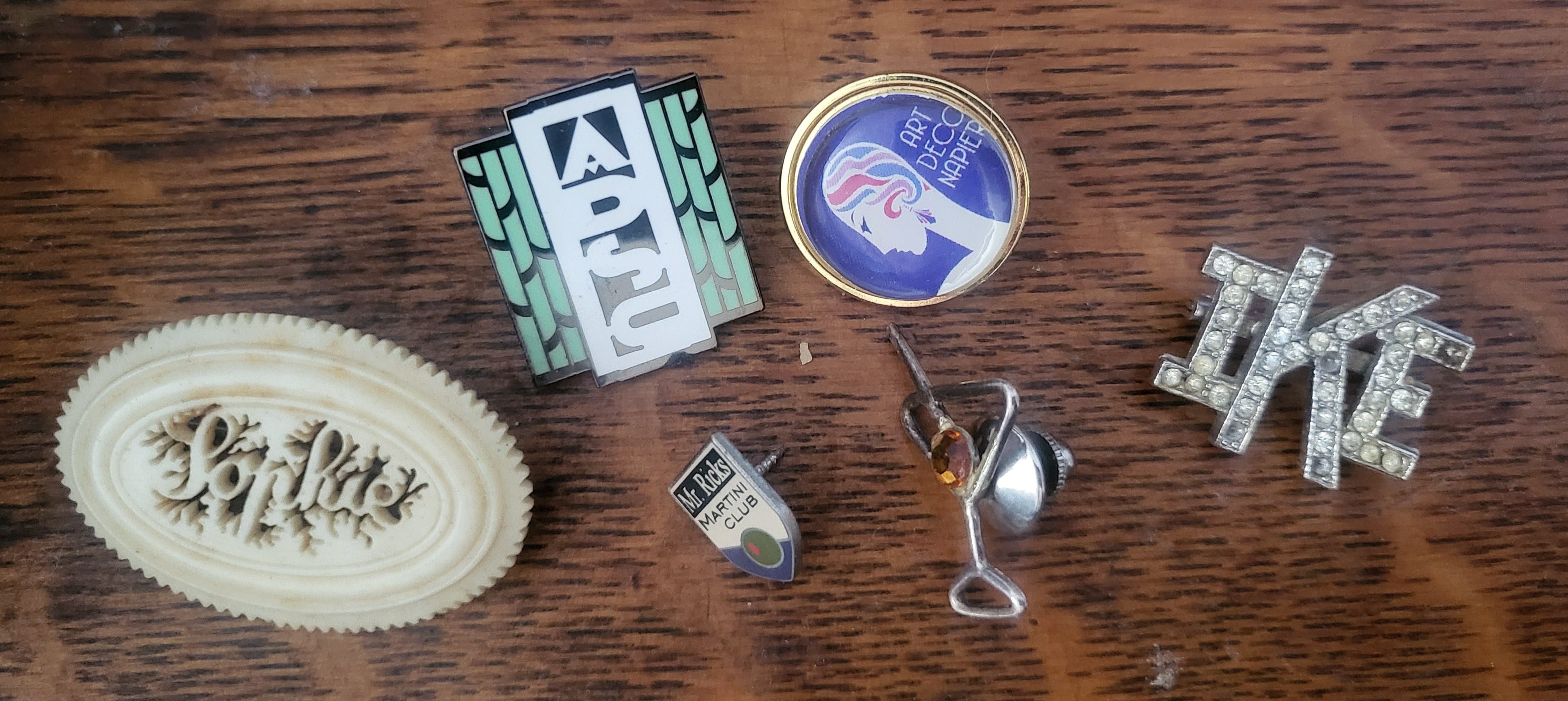
We talked at her home—she has been laying low—about the language barrier between generations, her principles for making people feel welcomed and comfortable at events, and the history of conical hats. Laurie, who has so generously mentored an entire community in the social arts that we joke about the “Laurie Gordon School of Charm,” tried to be gracious, even through her burning pain at feeling the community she built turn against her.
Breaking News:
In our conversation, Laurie Gordon answered many questions that had been on my mind, and everyone else’s, such as:
“Did you know the couple in the Chinese hats?” (No, she’d never met them.)
“Why didn’t you throw them out of the event?” (Because as an event professional she doesn’t believe in doing that for a costume issue.)
Why didn’t you make them wash off their exaggerated “yellowface” makeup?(That's a rumor…they were wearing normal evening makeup)
“Why didn’t you let the board throw them out of the event?” (She only gave her opinion; they could have chosen to.)
“Why didn’t you apologize?” (She did… but it wasn’t acknowledged.)
Laurie read me a letter she wrote to the board about her conversation she had with the offending couple after the event, as well as the letter she wrote to Marissa, in which she tried to model giving grace. We also talked about the meaning of words like “safe,” “incident,” and “appropriation,” and the generation gaps around language.
I know what it’s like inside volunteer-run organizations. I know how hard it is to created truly diverse events. I don’t think it’s fair to demand perfection, to conflate hurt with harm, bad taste with bad intent, shock with trauma, disagreement with gaslighting, (individual) bigotry with (structural) racism. Having written a book and blog on bullying and having been trained in grade school Restorative Justice, the line between expressing pain and striking back is always obvious to me.
Hurt people hurt people, as we say in the social-emotional and mental health biz. We need to heal, not hurt each other more. I don’t mind people speaking truth to power—I do it all the time. But I hate not using the grownup tools we have at our disposal to create transformation. Change is hard, and it’s not optional, but I think the community could have navigated this better.
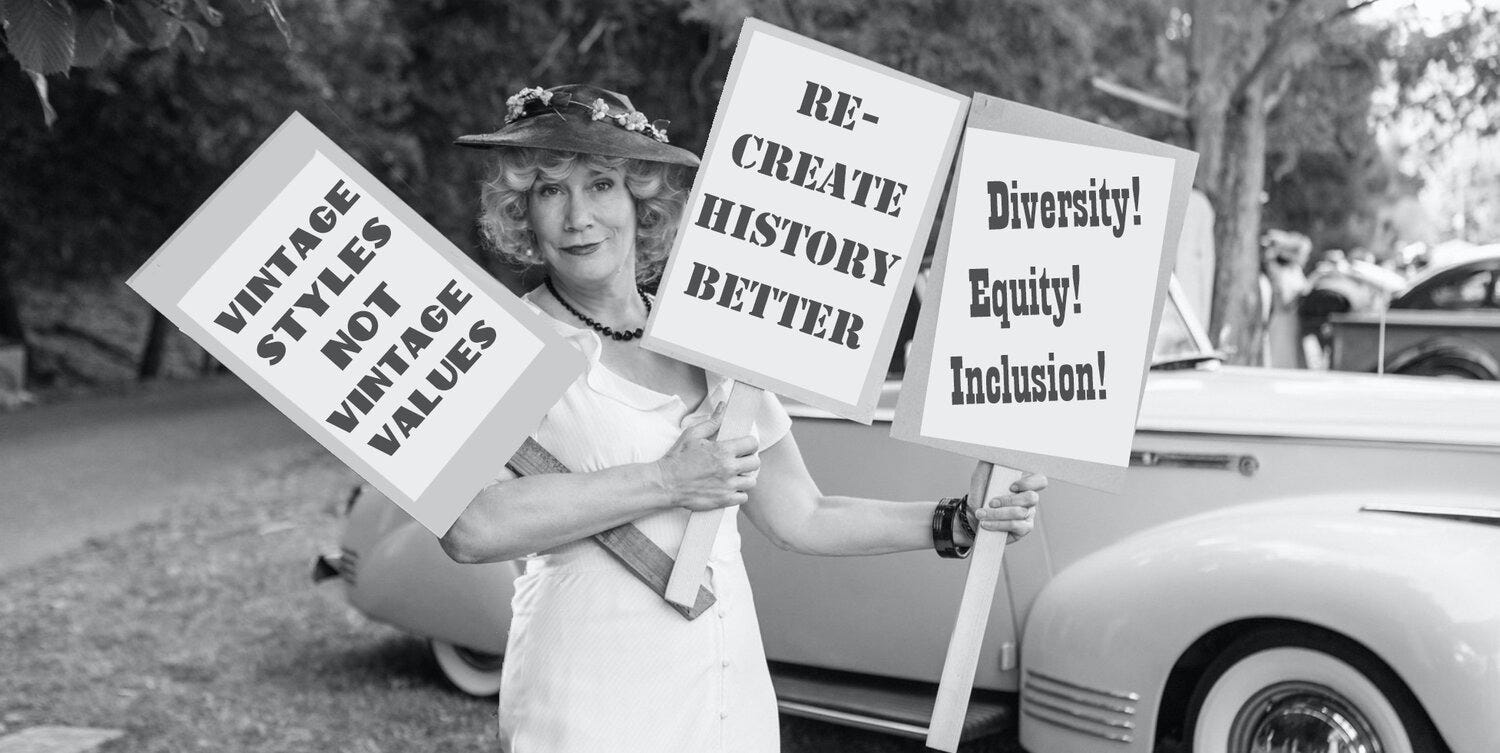
Funny story. In 2019, I attended “The Gatsby” lawn party (something a lot of people do now; did Laurie invent the trend?) dressed in white in homage to the suffragettes, and carried verbatim protest signs. I had so much fun with them that Laurie asked me to be the poster girl for the club’s new “Harassment Policy” page. I photoshopped some new slogans with her, then begged that the page’s name be changed to “Code of Conduct.” I worked with a team to rewrite the page in the voice of our social community. Then, ADSC leadership asked me to be on the Club’s DEI advisory committee. In one of our email sessions, I offered up a draft of a Bespoke Grievance Process that includes tea and cocktails. It got lost in the shuffle, and that’s the thing… there’s always a shuffle. I now wish I’d pushed for it harder; we could have used it this year. Being able to get along will save us, and fighting against each other will harm us all.
I am against proverbial babies being thrown away with bathwater. The ADSC may be perceived as exclusive and supremacist (it’s not), but overall it does far more good than harm. It creates a space for us all to work together, express ourselves creatively, celebrate the arts and culture, and explore our own evolution. Social cohesion is strength against fascism, which thrives on division and fear, actually targets minority groups, institutionalizes racism, and discourages dissent. Plus, Americans need to party more.
In the end, I realized I had again put dozens of hours of my life, which I intend to spend judiciously on positive change, into mopping up the mess created by clueless wealthy people. Multiply that by all my friends and fellow Decobelles who got twisted out of shape about this. How to stop that energy, for goodness sake?
As for Laurie, she acknowledges that she needs more education—just as we all do—but I hope she can find her footing again, her voice, her people, and her purpose.


